
React vs Next.js for business websites: A Strategic Overview
Why Next.js is becoming the default choice for business websites over standard React SPAs. An analysis of SEO, performance, and user experience.
Rohit Sharma
Engineering Strategy
Perspective
Practical engineering guidance
Depth
1 focused sections
Use it for
React vs Next.js for business · SEO for React
The Battle for the Web: Why Next.js is Winning the Corporate World
For an established business or startup, the website is often an important first product experience. A client-rendered React application can be appropriate for authenticated tools, but public acquisition pages usually need a deliberate rendering, metadata, performance, and accessibility strategy.
The Hidden Cost of Client-Side Rendering
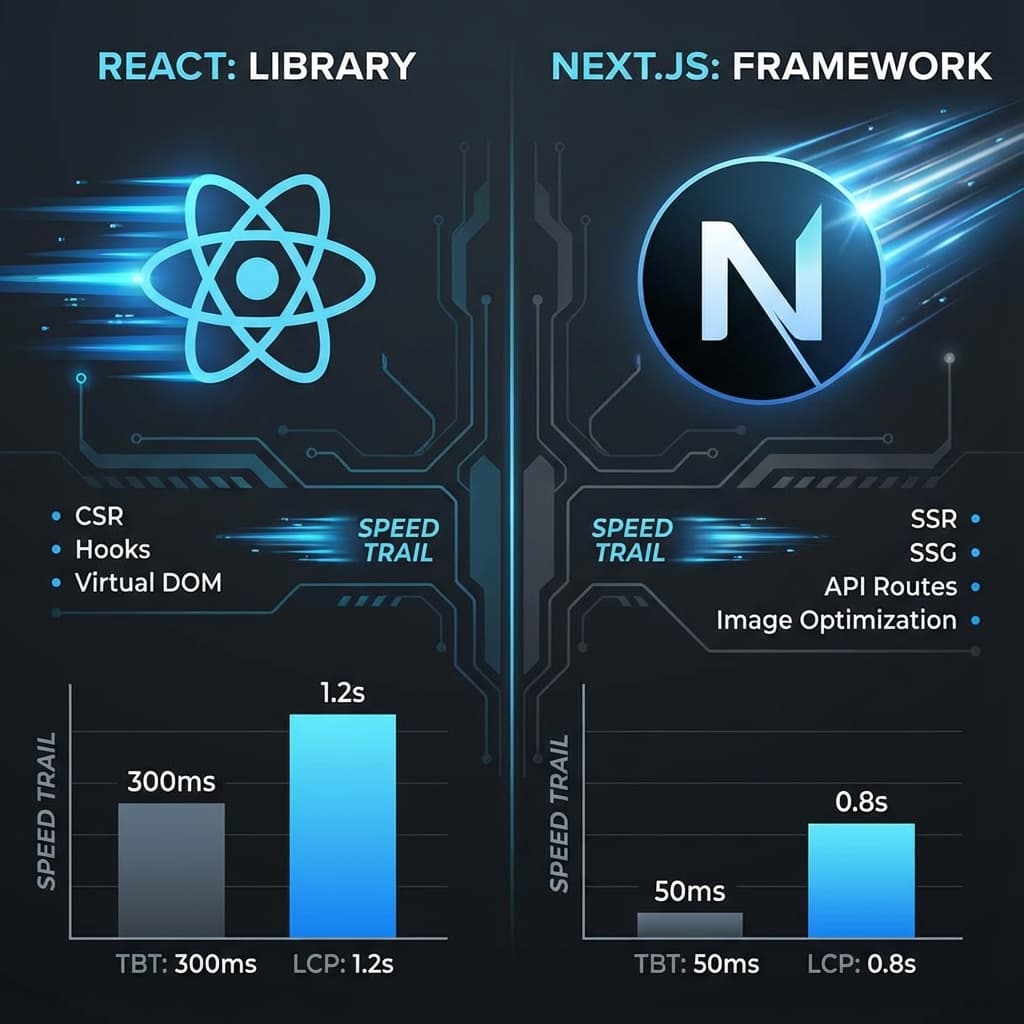
Standard React apps are "Single Page Applications" (SPAs). When a user (or a search engine) visits your site, they get a blank HTML page. The browser then has to download a massive JavaScript bundle, execute it, and fetch data before the user sees anything.
Why this is bad for business:
- Poor SEO: While Google is better at crawling JS, it is still inconsistent. Many smaller search engines and social media scrapers will fail to see your content.
- High Bounce Rates: Mobile users on slow connections might wait 5-10 seconds for the JS to load. They will leave before they ever see your product.
- Initial "Flash": Users often see a loading spinner or a blank page, which feels unprofessional.
The Next.js Revolution: Server Components and Beyond
Next.js solves these problems by moving the work from the user's phone to the server. By using Server-Side Rendering (SSR) and Static Site Generation (SSG), Next.js delivers the full HTML of your page to the browser instantly.
- Instant Indexing: Because the server sends the full content, Google can index every word on your site perfectly, leading to higher rankings.
- Superior Performance: Features like automatic Image Optimization, Font Optimization, and Script Loading ensure that your site gets a perfect 100/100 score on Google Lighthouse.
- Enhanced Security: By keeping sensitive logic on the server, you reduce the attack surface of your frontend.
When to Stick with Standard React?
There is only one place where standard React still makes sense: Gated Dashboards. If your application is behind a login screen and isn't indexed by Google, the complexity of Next.js might be unnecessary. But for everything else—Marketing Pages, Blogs, E-commerce, and Public Platforms—Next.js is the objective winner.
Transitioning Your Business
If you already have a React app, migrating to Next.js doesn't mean a total rewrite. You can adopt it incrementally, page by page. The return on investment (ROI) in terms of SEO traffic and conversion rates is usually apparent within the first 30 days of launch.
In today's digital economy, speed is a feature. Next.js gives your business that feature out of the box.