
01
Financial Accounting
Automated ledgers, multi-currency reporting, tax compliance, and seamless banking integrations.
Plan, configure, extend, and operate ERPNext around the workflows, integrations, data, and controls your organization actually needs.
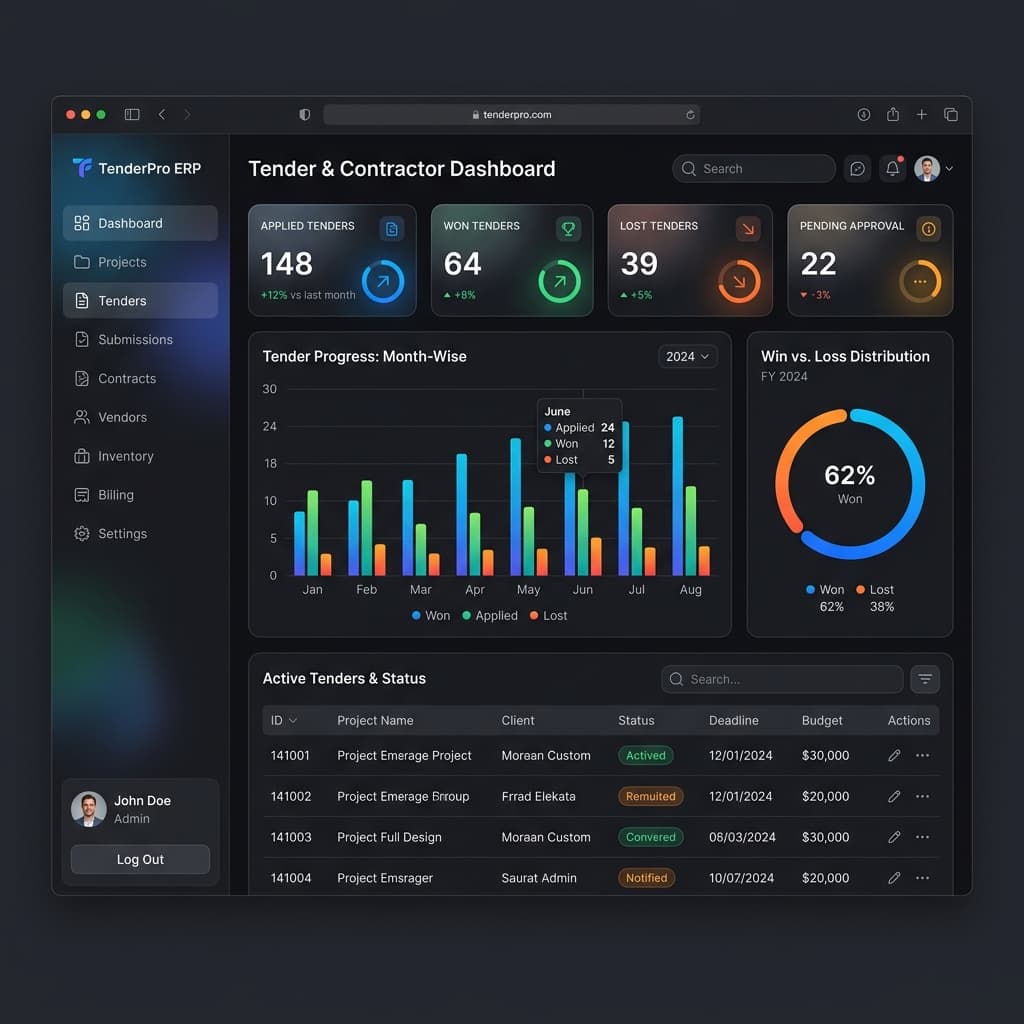
Illustrative system interface
Each model carries different implementation, licensing, customization, upgrade, and ownership responsibilities. These are the trade-offs to examine during discovery.
| Decision criteria | ERPNext | Proprietary ERP | Custom build |
|---|---|---|---|
| Foundation | Open-source business suite | Vendor-owned product | Purpose-built application |
| Best starting point | Established workflows with configurable gaps | Broad packaged processes and vendor ecosystem | Distinct operations that justify a new system |
| Customization | Configuration and Frappe applications | Vendor extension points and partners | Designed around the agreed scope |
| Upgrade responsibility | Planned by the operating team or partner | Strongly shaped by the vendor roadmap | Owned by the product engineering team |
| Cost profile | No proprietary product licence; implementation and hosting still apply | Contract and licence dependent | Higher initial build and ongoing ownership cost |
We configure, extend, and integrate the native ERPNext modules to create a single source of truth for your entire organization.
Automated ledgers, multi-currency reporting, tax compliance, and seamless banking integrations.
Real-time stock valuation, serial/batch tracking, and automated reorder points.
Multi-level Bill of Materials (BOM), capacity planning, and shop-floor routing.
Complex payroll processing, leave management, and employee lifecycle tracking.
A phased implementation keeps workflow decisions, data readiness, integrations, testing, and adoption visible before go-live.
Document current workflows, decision points, users, controls, and the processes worth changing before configuring modules.
Setting up the chart of accounts, writing custom Frappe apps for unique workflows, and designing print formats.
Profile source data, define mappings and validation, then rehearse migration and integration behavior before cutover.
Review real operating scenarios with the people responsible for the workflows, then prepare role-specific guidance.
A controlled rollout followed by intensive support to resolve any immediate operational friction.
An ERPNext implementation for a multi-company construction environment may need to connect tender pipelines, billing, material gate passes, inventory, finance, and site-facing workflows while preserving company-level controls.
Schedule a technical consultation to discuss your specific ERP requirements and migration challenges.